Double Nut Locking
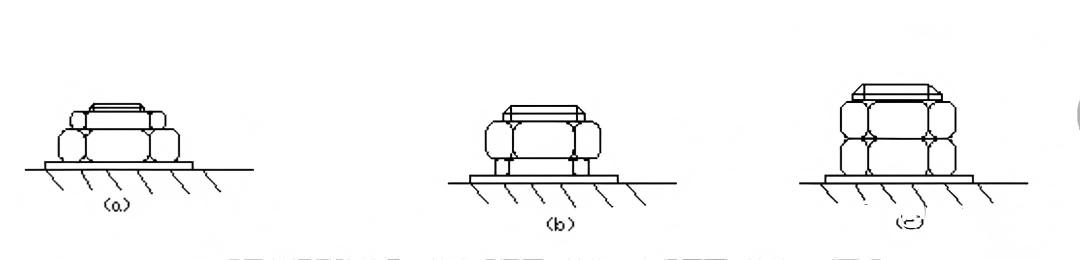
Use double-thread locking. The structure shown in Figure (a) is prohibited; instead, use the structure shown in Figure (b), with a thin nut at the bottom and a thick nut on top. However, considering that a wrench cannot access the thin nut at the bottom for tightening, only two thick nuts may be used, as shown in Figure (c).
2.The two positioning pins should be of different lengths.
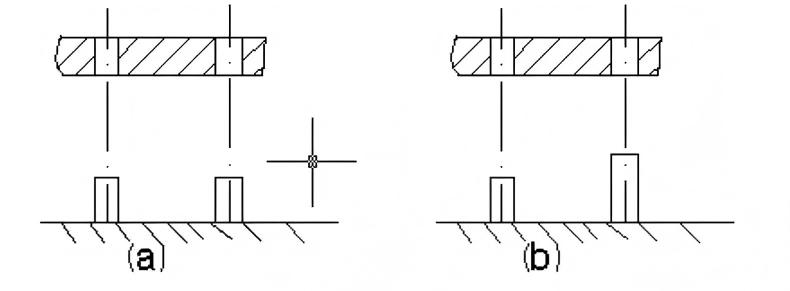
When assembling large boxes, several positioning pins are often required. It is forbidden to make all positioning pins the same height, as shown in Figure a. This is because it is difficult to align several pins simultaneously during box assembly. Instead, the pins should be of different lengths, as shown in Figure b. During assembly, alignment can be done with one pin first, making the process much easier.
3.Correct Configuration of Large and Small Gears in Gear Transmission
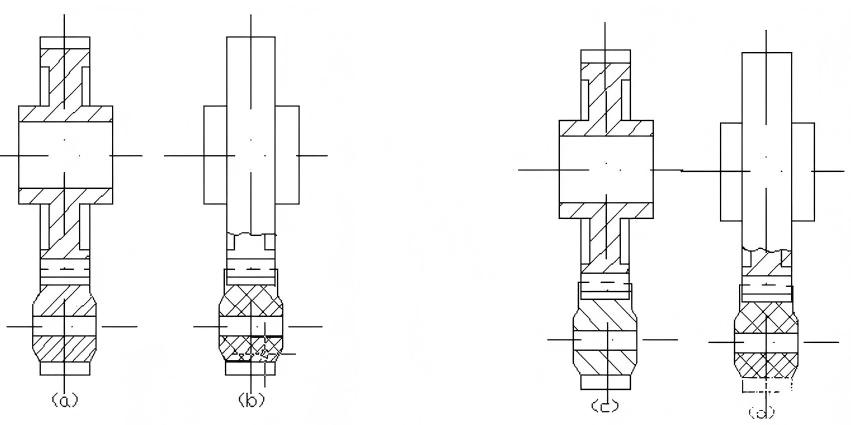
For ease of installation and to avoid step wear during gear operation, the face width of the small gear should generally be 5–10 mm wider than that of the large gear, as shown in Figure c. However, if the small gear is made of plastic, its face width should be narrower than that of the large gear, as shown in Figure d, to prevent indentations on the gear teeth.
4.Screw Joints for Frequent Assembly and Disassembly
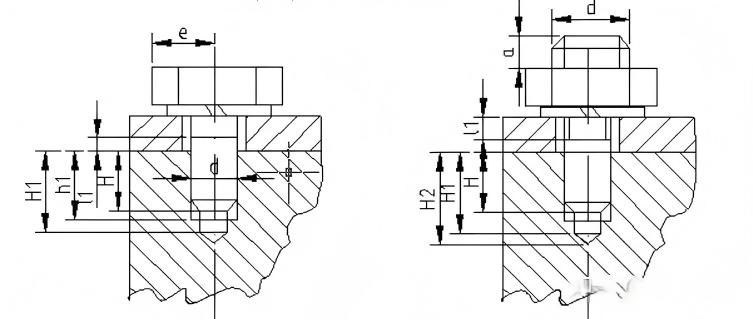
Screw joints, as shown in Figure a, are characterized by screws that are directly threaded into the tapped holes of the connected parts without using nuts. They feature a simple and compact structure, and are suitable for situations where bolt connections cannot be adopted due to structural constraints.
Screw joints are not recommended for applications with high loads or frequent assembly and disassembly. Frequent disassembly tends to wear the threads, which may result in the scrapping of the connected parts.
For applications requiring frequent assembly and disassembly, stud bolt connections should be used instead, as shown in Figure b.The installation depth is denoted as H:
For steel or carbon steel tapped holes: H ≈ d
For cast iron tapped holes: H = (1.25 ~ 1.5)d
For aluminum alloy tapped holes: H = (1.5 ~ 2.5)d
Thread depth: H₁ = H + (2 ~ 2.5)p, where p is the thread pitch.Drilling depth: H₂ = H₁ + (0.5 ~ 1)d.
5.Coupling Installation on High-Speed Shaft Near Bearing
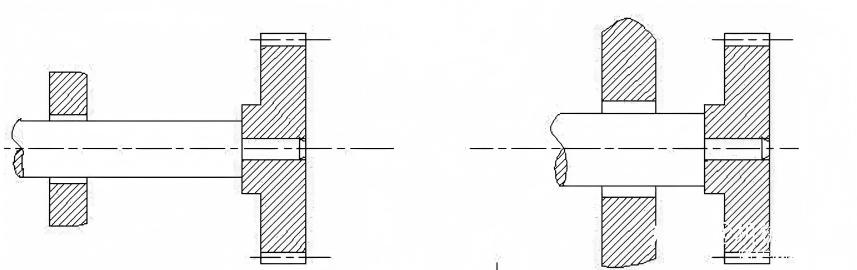
When installing a coupling on the overhung end of a high-speed rotating shaft, the structure shown in Figure a is prohibited.The overhang length should be minimized. The longer the overhang, the greater the deformation and the effect of unbalanced mass.
Therefore, when installing a coupling on the overhung end, in addition to minimizing the weight of the coupling, it should also be positioned as close to the bearing as possible.
6.Machining of Small-Diameter Deep Holes
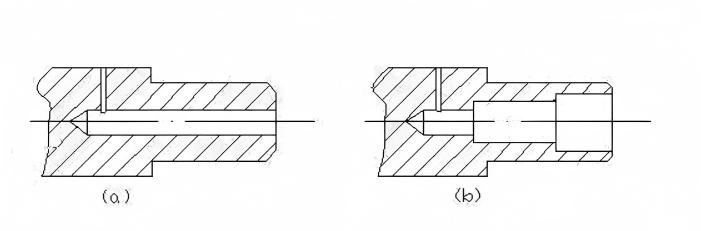
Machining small-diameter deep holes is difficult, costly, and inefficient. Designing deep, small-diameter lubrication holes on rotating shafts, as shown in Figure a, is prohibited.
Wherever possible, holes with a larger diameter should be used instead. If necessary, the holes should be designed with different diameters, as illustrated in Figure b.
 English