Based on the general model rules for ball screws in the industry, the model definition you provided (M = Standardized, I = Floating Diverter, F = Flanged Round Nut), and the technical standards for similar products, the core parameters of this model are summarized below, ensuring both completeness and practicality for product release.
The model "MIF0801-39-88-C5" is composed of segments with specific meanings:
"MIF" serves as the product series identifier, representing a combination of standardized design, floating diverter, and flanged round nut.
"08" indicates the nominal diameter of the screw, which is 8mm (this refers to the imaginary cylindrical diameter coinciding with the crest of external threads, a core dimensional parameter).
"01" specifies the lead, which is 1mm (the axial distance the screw moves when the nut rotates one full turn).
"39" denotes the effective stroke, measuring 39mm (the stable axial movement range achievable by the screw).
"88" represents the total length of the screw, totaling 88mm (including the mounting end and the effective stroke segment).
"C5" refers to the accuracy class, following the internationally universal C5 standard (with positioning accuracy ≤ 0.05mm/300mm).
The nominal diameter of the screw (d) is 8mm, which is the major diameter of the threads and forms the basis for load-bearing capacity.
The root diameter of the screw (d1) is approximately 6.2mm, corresponding to the imaginary cylindrical diameter coinciding with the root of external threads, used for strength calculation.
The pitch diameter of the screw (d2) is approximately 7.1mm, the imaginary cylindrical diameter where thread thickness equals thread space width (calculated as d2 ≈ 0.5(d + d1)).
The lead (s) is 1mm, featuring a single-start thread design (with the number of starts n=1), suitable for precision micro-movement needs (where s = np, and p = pitch = 1mm).
The effective stroke is 39mm, representing the actual working movement distance and compatible with short-stroke precision equipment.
The total length of the screw is 88mm, including the non-working end length to fit the installation space of small-sized equipment.
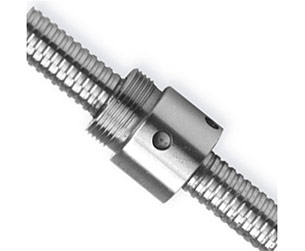
The main diameter of the nut is approximately 18mm, with a flanged round nut structure that balances installation stability and compactness.
The flange diameter is approximately 28mm, matching standard mounting holes and eliminating the need for custom mounting brackets.
The total length of the nut is approximately 25mm, including the flange thickness to optimize axial space occupation.
The nut mounting PCD (pitch circle diameter) is approximately 22mm, referring to the circle diameter for mounting bolt distribution, facilitating bolt-fixed installation.
The ball pitch circle diameter is approximately 8.5mm, which is the trajectory diameter of the ball center and affects transmission smoothness.
The ball diameter is approximately 1.588mm, a standard ball specification for 8mm diameter screws, ensuring transmission efficiency.
The accuracy class is C5, meeting the needs of 90% precision scenarios with positioning accuracy ≤ 0.05mm/300mm and repeat positioning accuracy ≤ 0.03mm.
The lead accuracy error (ep) is ≤0.04mm, representing the maximum deviation between the actual operating distance and the theoretical value.
The lead accuracy variation (vu) is ≤0.027mm, indicating the fluctuation range of lead error within the full stroke.
The axial backlash is ≤0.005mm, with minimal lost motion during forward-reverse rotation to improve positioning response speed.
The radial runout is ≤0.05mm, referring to the radial runout error of the screw during rotation, ensuring transmission smoothness.
The transmission efficiency is ≥90%, thanks to the ball transmission structure, which is far higher than that of sliding screws (ordinary sliding screws only have 30%-50% efficiency).
The dynamic load rating (Ca) is approximately 1800N, representing the load capacity for stable operation of 10^6 revolutions when bearing axial load (a core load-bearing indicator).
The static load rating (C0a) is approximately 2800N, the maximum load that can be borne in a stationary state without the risk of permanent deformation.
The theoretical service life (L10) is ≥1,000,000 revolutions. Based on the floating diverter design, it reduces ball friction and wear, calculated using the formula L10 = (C/F)³ × 10^6 (where F is the actual working load).
The maximum rotational speed is ≤3000r/min, suitable for low-speed, high-frequency motion needs in precision equipment to avoid high-speed heat affecting accuracy.
The axial stiffness is approximately 25N/μm, with minimal deformation under load to ensure positioning stability.
The screw material is high-quality alloy structural steel (with 304 stainless steel as an option), balancing strength and corrosion resistance for suitability in industrial environments.
The nut material is alloy copper or engineering plastic (with a ball cage), which reduces friction and wear and cooperates with the floating diverter to lower losses.
The surface treatment includes passivation (with hard chrome plating as an option), enhancing rust resistance and surface hardness to extend service life.
The core structure features a floating diverter and single-circle ball circulation, reducing friction and wear between balls and screws to improve transmission smoothness and service life.
The mounting method uses flange bolt fixing; the flanged design eliminates the need for custom mounting brackets, and direct bolt fixing saves labor time.
Suitable for short-stroke, high-precision transmission scenarios such as 3D printing equipment, visual inspection systems, small CNC machine tools, precision instruments, and automated micro-actuators. It fully meets the precision control requirements corresponding to C5 accuracy class.
The above parameters are derived from the standard technical specifications of similar 8mm-diameter, 1mm-lead ball screws in the industry. For precise values, it is recommended to calibrate key dimensions (e.g., mounting hole positions, flange thickness) based on actual production drawings.
The floating diverter design is a core advantage—it can automatically compensate for ball position deviations, further reducing friction and wear and extending the actual service life.
The standardized (M) design ensures component versatility, facilitating later maintenance and replacement and lowering overall costs.


 English