5. Overload Capacity
5.1 Overload Capacity of Stepper Motors
Stepper motors generally do not have overload capacity, a characteristic determined by their open-loop control mechanism. The maximum output torque of a stepper motor is fixed during the design phase; once the actual load exceeds this value, the motor will experience step loss, resulting in position control errors. Step loss refers to a situation where the stepper motor fails to rotate in accordance with the input pulse signals due to excessive load, thus losing position control.
This characteristic requires that a sufficient safety factor be considered during stepper motor selection to ensure stable operation under rated torque. For example, relevant research indicates that in practical applications, a safety factor of 1.5 to 2 times is often required when selecting stepper motors to prevent step loss.
5.2 Overload Capacity of Servo Motors
In contrast, servo motors have strong overload capacity. The closed-loop control of servo motors allows the system to provide additional torque by increasing current during startup or sudden load changes, thereby overcoming the resistance of inertial loads. This overload capacity enables servo motors to withstand loads higher than the rated torque for a short period without losing control.
For instance, experimental data shows that some servo motors can deliver 3 times the rated torque at the moment of startup to overcome the high inertial torque during initialization. This overload capacity makes servo motors more reliable in applications requiring rapid start-stop operation and the ability to handle sudden load variations.
5.3 Comparative Analysis
The differences in overload capacity between stepper motors and servo motors are mainly reflected in their response and handling capabilities for sudden load changes. Due to the lack of overload capacity, stepper motors are highly sensitive to load fluctuations and prone to step loss once the load exceeds the rated torque, which limits their application in scenarios with large load variations or rapid start-stop requirements.
In contrast, thanks to their closed-loop control and overload capacity, servo motors can withstand and overcome high loads in a short time while maintaining stable system operation. This characteristic makes servo motors more suitable for applications requiring high load-bearing capacity or rapid response, such as industrial robots and precision robotic arms.
6. Speed Response Performance
6.1 Speed Response Performance of Stepper Motors
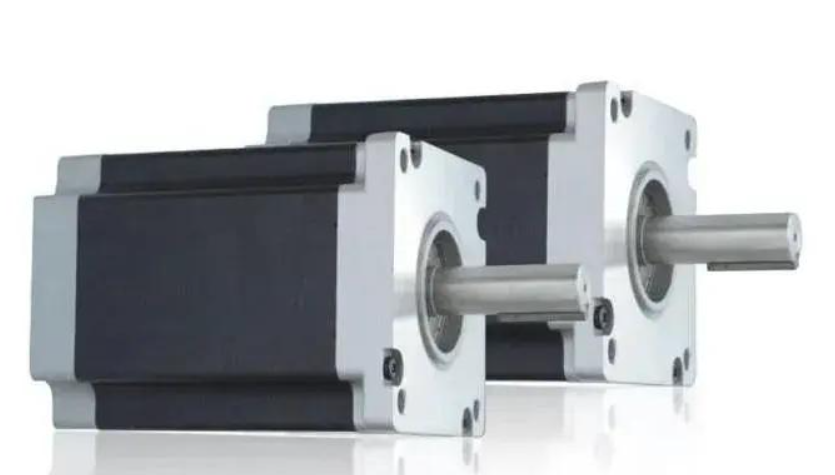
The speed response performance of stepper motors is limited by their open-loop control characteristics. It takes a stepper motor 200–400 milliseconds to accelerate from a standstill to its operating speed (usually several hundred revolutions per minute). This speed response limitation restricts the application of stepper motors in scenarios requiring rapid start-stop operation and high-speed response.
Since stepper motors rely on pulse signals for speed control, their acceleration and deceleration control is not sufficiently flexible, resulting in poor performance in applications involving rapidly changing loads or demanding fast response. For example, experimental data shows that when stepper motors start and stop at high speeds, position deviation may occur due to acceleration and deceleration limitations, which impairs positioning accuracy.
6.2 Speed Response Performance of Servo Motors
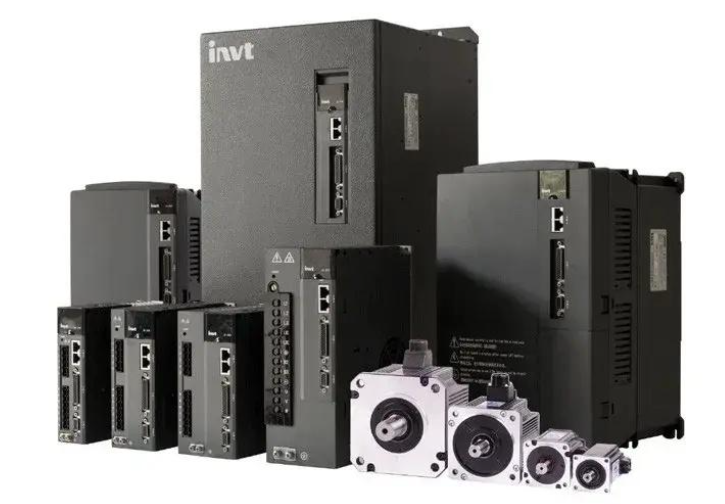
In contrast, the speed response performance of servo motors is significantly superior to that of stepper motors. A servo motor system—such as the Panasonic MSMA400W AC servo motor—can accelerate from a standstill to its rated speed of 3000 RPM in just a few milliseconds. This rapid acceleration performance makes servo motors highly suitable for control scenarios requiring quick start-stop operation.
The closed-loop control structure of servo motors allows the system to monitor and adjust motor speed in real time in response to changes in external loads, thereby achieving precise speed control. This fast response capability enables servo motors to deliver outstanding performance in applications requiring rapid speed changes and high dynamic performance, such as CNC machine tools and robotics.
6.3 Comparative Analysis
The differences in speed response performance between stepper motors and servo motors are mainly reflected in acceleration time and dynamic response capability. Due to their open-loop control characteristics, stepper motors have a long acceleration time and may experience step loss during high-speed operation, which affects speed stability and control accuracy.
On the other hand, with their closed-loop control and fast response capability, servo motors can reach high speeds in a short time and maintain stable speed control. Even under conditions of load variation or high-speed start-stop operation, servo motors can still ensure precise position control. This difference in speed response performance makes servo motors more suitable for applications requiring fast and accurate control, whereas for stepper motors, designers need to take their speed response limitations into account and adopt corresponding measures to compensate.
7. Conclusion
After conducting an in-depth study on the differences between stepper motors and servo motors, we can draw the following conclusions:
7.1 Differences in Control Systems
As an open-loop control component, the stepper motor features simple control and low cost, but at the expense of speed control accuracy and dynamic response capability. In contrast, the servo motor adopts closed-loop control and achieves high precision and fast dynamic response through encoder feedback, making it suitable for applications with stringent control requirements.
7.2 Comparison of Low-Frequency Characteristics
Stepper motors tend to generate resonance and vibration when operating at low frequencies, requiring additional damping measures for improvement. On the other hand, servo motors can maintain stable operation even at low speeds without the need for extra damping solutions, thus being applicable to scenarios with high requirements for vibration reduction and smooth operation.
7.3 Comparison of Torque-Frequency Characteristics
The output torque of stepper motors decreases as the rotational speed increases, which limits their performance in high-speed applications. Servo motors, however, can provide constant torque output over a wide speed range, making them suitable for applications requiring extensive speed regulation and constant torque output.
7.4 Comparison of Overload Capacity
Stepper motors generally lack overload capacity and are highly sensitive to sudden load changes, which may easily lead to step loss. In contrast, servo motors have strong overload capacity, enabling them to withstand and overcome high loads in a short time while maintaining stable system operation.
7.5 Comparison of Speed Response Performance
Stepper motors have a long acceleration time and may experience step loss during high-speed operation, which affects speed stability and control accuracy. Servo motors, by contrast, can reach high speeds in a short time and maintain stable speed control. Even under conditions of load variation or high-speed start-stop operation, they can still ensure precise position control.
In summary, stepper motors and servo motors each have their own advantages and limitations, and the selection must be determined according to the specific requirements of the application. Stepper motors are suitable for cost-sensitive applications with low requirements for speed control, while servo motors are more appropriate for scenarios demanding high precision, high dynamic performance and fast response.
.jpg "791e1f14514adef9bd2dd1bcb686dbe3(1).jpg")
 English