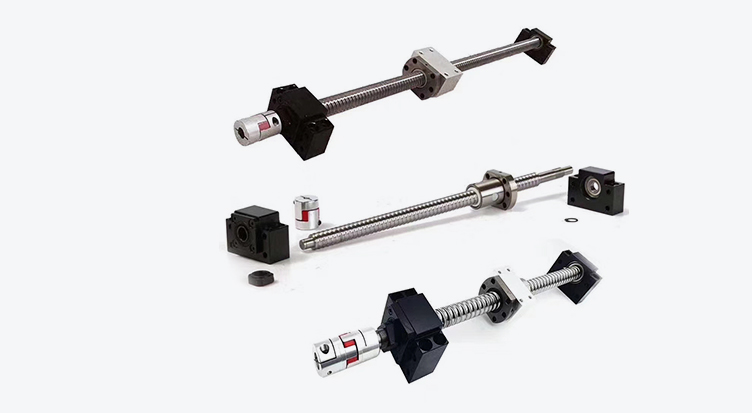
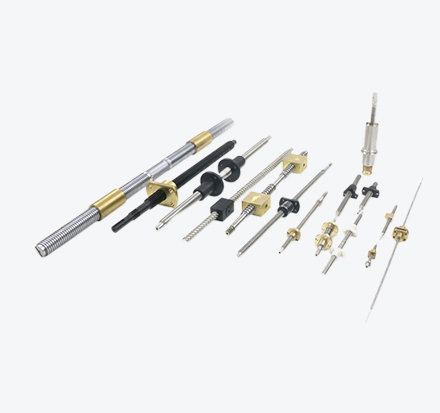
Ball screws can be classified according to its circulation method, manufacturing process, and special applications.
There are many ways to classify ball screws:① By ball circulation method: They can be categorized into internal circulation, external circulation, end-cap external circulation, and nut-rotating ball screws.② By manufacturing process: They can be categorized into ground ball screws and cold-rolled ball screws.③ By special application scenarios: They can be categorized into high-load, self-lubricating, silent, and high-speed ball screws.
Ball screws can be classified into internal circulation, external circulation, and nut-rotating types based on whether the ball’s return path leaves the screw’s raceway. External circulation generally refers to the tube-type and end-cap designs.
The balls do not leave the surface of the screw shaft during circulation. Internal circulation ball screws are equipped with deflectors that connect adjacent raceways. After the balls pass over the crest of the thread, they are guided back to the starting raceway via the return groove on the deflector.
Advantages: This design results in a smaller nut outer diameter, allowing for compact and miniaturized designs that fit in minimal installation spaces. They are also simpler to manufacture and lower in cost.
Applications: Internal circulation screws are suitable for scenarios with small to medium leads and low to medium speeds, such as 3D printers and small to medium-sized medical scanners.
The balls leave the surface of the screw shaft during their return journey.
Tube-type External Circulation:This is the most common and versatile design, often used as a standard product. A formed, bent tube is inserted into the helical raceway. The tongue-shaped, angled end of the tube acts as a ball deflector, guiding the balls into and out of the tube to form the circulation path.
Advantages: It features a simple structure, reliable operation, good manufacturability, and is easy to mass-produce. Compared to internal circulation, it can achieve larger leads and higher load-carrying capacity.
Applications: Its versatility makes it widely used in both heavy-load, high-speed drive systems and precision positioning systems, and it can accommodate both large and small leads.
End-cap External Circulation:This design can accommodate multi-start threads and is used in multi-port designs. Ball deflectors are positioned at the ends of the nut, and through-holes are drilled within the nut itself. The balls complete their circulation by passing through these end caps and the internal through-holes in the nut’s raceway.
Advantages: The nut has smaller radial and axial dimensions. It can achieve multi-start threads and offers a high load-carrying capacity.
Disadvantages: The machining of the ball circulation paths is more complex.
Applications: It is suitable for applications in industries requiring multi-start threads, high load, low rotational speed, and low precision transmission.
Ball screw production involves numerous steps, and controlling the yield rate is a key challenge. Due to its complex structure, manufacturing a ball screw requires many processes. In addition to intricate cold working, there are also heat treatment steps such as pre-heat treatment, quenching of the thread raceway, and intermediate aging treatment. Producing a single ball screw typically involves more than 20 individual steps, making yield control a significant challenge in production.
While ball screws serve diverse downstream applications with varying performance requirements, the overall manufacturing process is relatively standardized, with only slight differences in materials and key processes. From a technological standpoint, ball screws can be broadly classified into two categories: ground ball screws and cold-rolled ball screws.
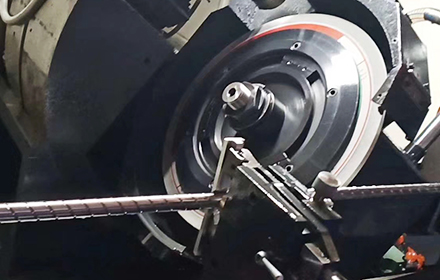
The manufacturing process for ground ball screws is complex, but it achieves much higher precision. Following the principle of datum unification, the process uses the center holes at both ends as the primary reference for all machining operations. It goes through dozens of steps, including heat treatment, turning, and grinding, to complete each component. The manufacturing precision can be as high as P1 class, making them ideal for use as positioning components in high-precision equipment. Furthermore, the choice of material and heat treatment method has a profound impact on the manufacturing quality and final precision of the ball screw.
Cold-rolled ball screws offer a higher degree of automation in production, have a shorter manufacturing cycle, but achieve lower precision. They are manufactured using cold-working dies, a process with a high level of automation. Once the dies are set up, mass production becomes cost-effective and efficient. However, the manufacturing precision is relatively low, typically around P7 class, limiting their use to transmission components within equipment rather than high-precision positioning roles.
To meet the diverse demands of downstream applications and adapt to working environments across various industries, ball screws designs have evolved to include specialized features. Based on their unique functions, characteristics, and specific uses, ball screws types can be categorized as follows:
These are designed to bear substantial axial loads. High-load ball screws employ a special geometric thread groove and return system design, which distributes the axial load more effectively across the thread grooves, thereby reducing stress concentration and enhancing the maximum load capacity of the ball screw.
Advantages: Compared to standard ball screws designs, their rated load capacity is significantly increased, often by more than 2 to 3 times. This allows them to deliver a much longer service life under heavy-load conditions.
Applications: They are widely used in all-electric injection molding machines, semiconductor manufacturing equipment, heavy-duty brakes, industrial machinery, and forging presses.
These maintain optimal lubrication and extend maintenance intervals. Self-lubricating ball screws are equipped with replaceable oil reservoirs. They eliminate the need for complex lubrication piping systems and related equipment.
Advantages: The oil reservoirs are easy to replace and refill manually, without requiring the disassembly and reassembly of the ball screw or the entire machine. This saves significant maintenance time and reduces the costs associated with oil changes and waste oil disposal.
Applications: They are widely used in printing machinery, automation equipment, medical devices, X-Y tables, and other industrial and electronic machinery.
 English