In mechanical design and daily use, the idea that higher hardness equals better wear resistance has become deeply ingrained common sense. People check hardness when buying cutting tools, selecting mechanical parts, or even choosing phone screens. But is this really true?
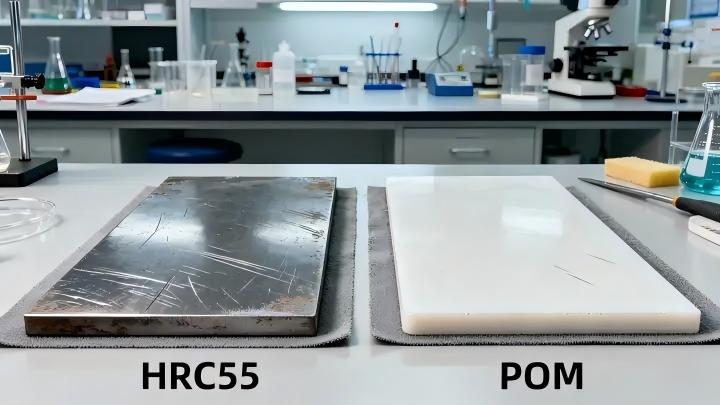
Take a piece of steel with a hardness of HRC55 and a sheet of POM plastic: there is no doubt that the steel is much harder. However, if you rub both materials repeatedly with the same sandpaper, you will find that the POM plastic shows less wear and fewer scratches.
This proves that high hardness does not equal good wear resistance. Wear resistance is never a one‑dimensional measure of “hardness”; it is a long‑term durability performance determined by multiple factors working together.
To understand that hardness ≠ wear resistance, we first need to clarify the difference between them.
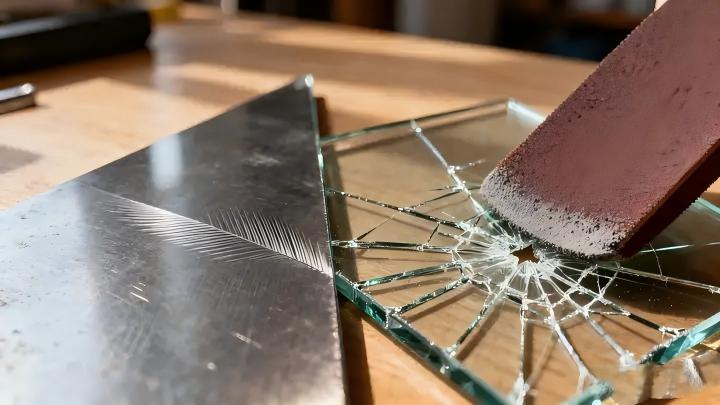
Hardness is a material’s ability to resist local deformation, indentation, or scratching. It can be understood as resistance to a single impact.For example, glass can easily scratch steel because it is harder. However, when rubbed repeatedly with sandpaper, glass will break quickly.
Wear resistance is a material’s ability to maintain its shape and properties under long‑term friction and abrasion. It represents durability for long‑term service.
It requires the material not only to resist scratching but also to withstand impact, deformation, and even temperature changes caused by friction.
Wear resistance is determined by multiple factors, not just a single variable.
First is hardness. Hardness can be considered the foundation of wear resistance, but it is not everything.
Hardness is a prerequisite: without sufficient hardness, a material will be quickly scratched and worn away.
For example, mild steel has low hardness and will rapidly thin and deform under abrasive friction. In contrast, bearing steel, after quenching, gains much higher hardness and shows greatly improved wear resistance.
However, focusing only on hardness while ignoring other factors often backfires.
For instance, high-hardness ceramic parts seem extremely hard but cannot withstand even slight impacts. They fracture easily on collision and are unsuitable for long-term use.
Second is toughness.
Toughness refers to a material’s ability to resist fracture and deformation, acting like a protective buffer for wear resistance.
For example, glass is much harder than rubber, but when rubbed with sandpaper, glass breaks easily due to insufficient toughness.
In mechanical design, many wear-resistant parts use a composite structure called “hard shell, soft core”:
a high-hardness wear-resistant layer on the surface, and a high-toughness base material at the core.
This design provides both wear resistance and impact resistance, such as composite buckets for excavators and surface-hardened layers on gears.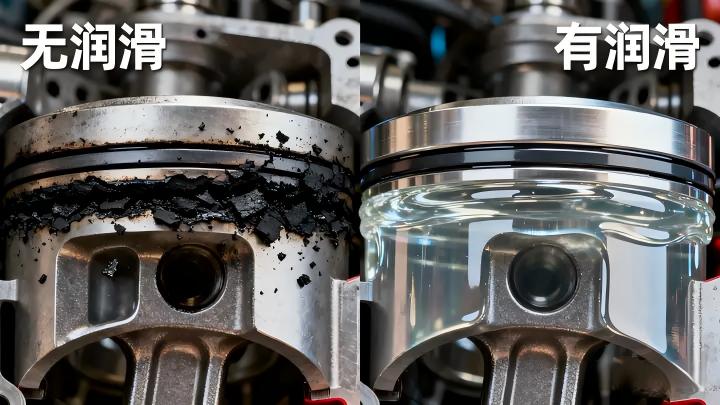
Finally, there is surface lubrication.
Lubrication is a key factor in improving wear resistance. It can even increase the wear resistance of ordinary materials by more than 10 times.
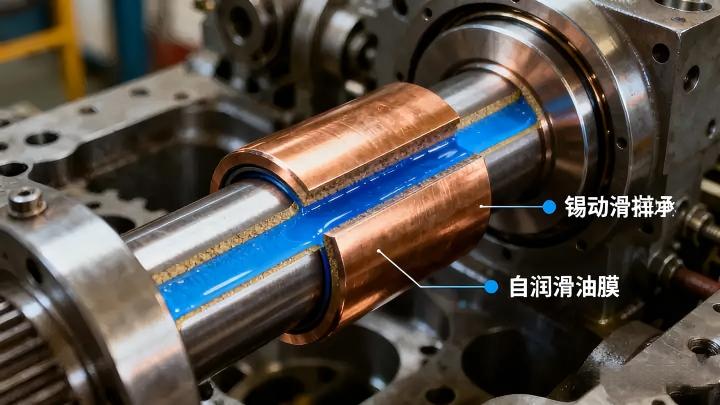
POM and PEEK plastics are more wear-resistant than steel precisely because they have self-lubricating properties. The same is true for tin bronze. This is why tin bronze is widely used for many sliding bearings.
When a lubricant (such as engine oil or grease) forms a film between two friction surfaces, it prevents direct contact between the materials, converting dry friction into fluid friction and greatly reducing wear.
A typical example is the piston ring in an automobile engine:
Without lubrication, the piston ring and cylinder wall wear out rapidly and seize up.
With regular oil changes and proper lubrication, the piston ring can operate normally for more than 100,000 kilometers.
This is why machinery maintenance manuals always emphasize the importance of adding lubricant on schedule.
 English