I. What is the self-locking property of trapezoidal lead screws
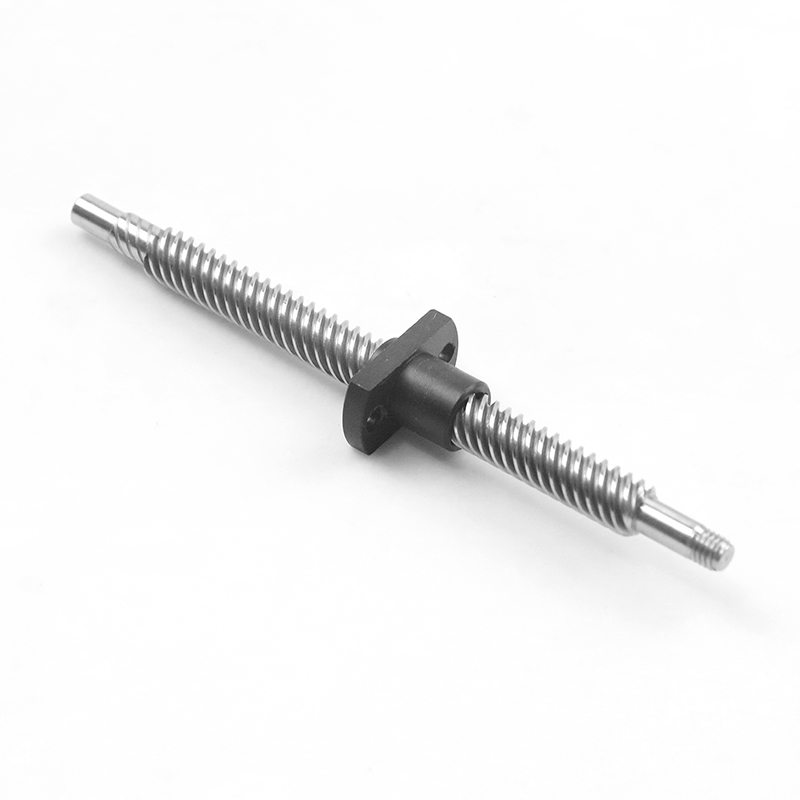
Self-locking refers to the ability of a trapezoidal lead screw to automatically maintain its current position without external force, and not rotate or slide backward under load. This feature is widely used in lifting platforms, lifting mechanisms, mechanical fixtures, and other applications requiring stable positioning.
Unlike ball screws, which have low friction and no self-locking capability, trapezoidal lead screws can achieve effective self-locking when conditions are met due to their friction angle.
II. Working Principle of Self-Locking in Trapezoidal Lead Screws
The self-locking property of trapezoidal lead screws is based on the principle that the friction angle (φ) of the thread pair is greater than the helix angle (α).
Helix angle α = arctan(lead / (π × pitch diameter))Friction angle φ = arctan(friction coefficient μ)
Self-locking occurs when the following condition is satisfied:α < φ
This means the friction force is sufficient to resist the reverse thrust generated by the load along the rotation direction of the screw, thus achieving self-locking.
III. Factors Affecting the Self-Locking Ability of Trapezoidal Lead Screws
Thread LeadThe smaller the lead, the smaller the helix angle, making self-locking easier to achieve.Multiple-start threads have a larger lead and helix angle, which tends to lose self-locking.It is recommended to use single-start trapezoidal lead screws for better self-locking performance.
Friction Coefficient (μ)The higher the friction coefficient between the nut and the screw, the stronger the self-locking effect.Common pairings: steel‑brass nuts and steel‑engineering plastic nuts provide good self-locking.Lubrication reduces the friction coefficient and thus weakens self-locking, so lubrication methods should be used with caution.
Load Direction and GravitySelf-locking mainly functions to maintain position when the load attempts to push the screw backward.In vertical lifting applications, self-locking structures prevent sudden drops and ensure equipment safety.
IV. How to Design a Self-Locking Trapezoidal Lead Screw System
Select single-start trapezoidal threads with a small lead (e.g., Tr16×2).
Use nuts made of materials with a high friction coefficient, such as brass or POM.
Avoid excessive lubrication, or choose dry-friction material combinations.
Design a locking structure or spring-assisted mechanism to enhance holding force.
Add a brake device as a redundant safety measure when necessary.
V. Typical Applications of Self-Locking Trapezoidal Lead Screws
Lifting platforms or electric height-adjustable desks
Screw jacking devices (such as jacks)
Gravity-loaded fixtures and clamps
Telescopic mechanical structures
Safety braking auxiliary equipment
 English